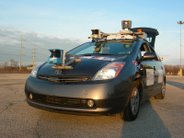
We spent the day working on demonstrating intersection navigation including vehicle avoidance. We were able to demonstrate intersection navigation with empty obstacle maps. However we ran into technical difficulties when trying to translate the maps generated by the velodyne to the
planner.
Paul has helped me out and the Velodyne can render beautiful point clouds in real time. Now that we have the correct calibration for our unit we can watch people walk down the sidewalk from 20m away, and see 5+ cars around a busy intersection. Hopefully we can post some of the recorded data into videos soon.
Tully
Monday, April 9, 2007

Monday, March 26, 2007
Video Demo - Proof of concept test
Today we took Ben out to the car-park to test the LADAR
integration with the video-demonstration code - in short, after
debugging/fixing we were able to reliably transform the LADAR data
into a usable map, evaluate our plan through the map and correctly
identify Tully's car as an obstacle in our path, stop in front of it
and then transition to the other available lane and then transition
back to the first lane after passing Tully's car - this was all at
about 5mph.
We were also able to demonstrate that trajFollower could drive the
video-demo course that Jim laid out at park and we took the
reporter who came out with us around the course a couple of times and
she seemed suitably impressed. Heeten was also able to make
significant progress on testing the RNDF generator that uses the
google-map-esque interface.
There are still some issues that we need to resolve, primarily
concerned with the quality of the LADAR maps when driving at higher
speeds and making reasonably sharp bends, both of which frequently
lead to significant obstacles being painted into the map, although
these are rarely sufficiently high to be viewed as obstacles to plan
around by the video-demo code, the performance should be better than
it is now.
Alex
integration with the video-demonstration code - in short, after
debugging/fixing we were able to reliably transform the LADAR data
into a usable map, evaluate our plan through the map and correctly
identify Tully's car as an obstacle in our path, stop in front of it
and then transition to the other available lane and then transition
back to the first lane after passing Tully's car - this was all at
about 5mph.
We were also able to demonstrate that trajFollower could drive the
video-demo course that Jim laid out at park and we took the
reporter who came out with us around the course a couple of times and
she seemed suitably impressed. Heeten was also able to make
significant progress on testing the RNDF generator that uses the
google-map-esque interface.
There are still some issues that we need to resolve, primarily
concerned with the quality of the LADAR maps when driving at higher
speeds and making reasonably sharp bends, both of which frequently
lead to significant obstacles being painted into the map, although
these are rarely sufficiently high to be viewed as obstacles to plan
around by the video-demo code, the performance should be better than
it is now.
Alex
Monday, March 12, 2007
Autonomous Trails
A video of autonomous trails by little ben, the ben franklin racing team's car.
Following a marked course, avoiding an unexpected pedestrian crossing the road and following a leading car.
Following a marked course, avoiding an unexpected pedestrian crossing the road and following a leading car.
Monday, February 19, 2007
Ice Accident
Hi there,
I've got some bad news. Ben will be out of service for a little while. While we were getting Ben setup in front of the Levine loading dock, a large bunch of ice fell off the roof of Fisher Bennett and smashed our windshield, hood, and right mirror. The ladar's were on the roof and one took enough of a hit to knock it cockeyed on it's mount, but it tested ok in the lab afterwards.
The only major problem with Ben is the windshield, it's pretty opaque and obviously compromised. The mirror needs to be replaced. And the hood is cosmetic, but probably a good thing to fix so we don't look like we got into an accident. All other systems are fine.
In the good news. None of us were hurt. As the first smaller stuff came down we moved away. Also, we now successfully have tested LADAR producing elevation maps feeding directly into matlab and then feeding a map to the planner. We were on our way out to record some data to try planning through when the ice fell.
Here are some pictures:
Tully
I've got some bad news. Ben will be out of service for a little while. While we were getting Ben setup in front of the Levine loading dock, a large bunch of ice fell off the roof of Fisher Bennett and smashed our windshield, hood, and right mirror. The ladar's were on the roof and one took enough of a hit to knock it cockeyed on it's mount, but it tested ok in the lab afterwards.
The only major problem with Ben is the windshield, it's pretty opaque and obviously compromised. The mirror needs to be replaced. And the hood is cosmetic, but probably a good thing to fix so we don't look like we got into an accident. All other systems are fine.
In the good news. None of us were hurt. As the first smaller stuff came down we moved away. Also, we now successfully have tested LADAR producing elevation maps feeding directly into matlab and then feeding a map to the planner. We were on our way out to record some data to try planning through when the ice fell.
Here are some pictures:
Tully
Friday, February 16, 2007
(Great) Testing Results Featured in the Philadelphia Inquirer
We had a really fantastic testing day today - the steering control is now really good and very smooth (no jerking steering wheel etc - it actually looks like a human is driving). We did have a reasonably persistent problem with the GPS jumping near the poles in the car park which is why we have some discrete jumps in the route traces - but this is something that we are investigating several different avenues to solve (new pose system, pose filter changes etc). Hence we got a lot of recorded data using benracer.dangerous (keyboard arrow control of the vehicle controls - great fun) of human driving and throttle/brake characterisation data so we should be able to build a good map of the throttle-brake characteristics to use in a new longitudinal controller.
The Philadelphia Inquirer reporter and photographer met us took photos of Ben and we took the reporter for a spin in the driving seat (with Ben driving) which he seemed to enjoy - read more about it and watch a video of the car here:
http://www.philly.com/mld/inquirer/16709897.htm
http://www.philly.com/mld/inquirer/16709897.htm
However - we also had a minor problem:
We smelt burning plastic in the car and stopped immediately - when we looked in the boot (trunk) we found that we had melted (the casing) *and* fried the wires connecting the 400V inverter to the 12V power supplied from the vehicle.
Alex
Thursday, January 18, 2007
Another Day in The Field
On Sunday we tested a new trajectory follower which is based on a value-function. The pose estimator was tested integrating all sensors including GPS, IMU, and car odametery.
The video production team is working on a promotion video of little ben performing an autonomous run which will display our GUI to the brains of the car.
The video production team is working on a promotion video of little ben performing an autonomous run which will display our GUI to the brains of the car.
Friday, January 5, 2007
Driving by the RNDF
Jim, Alex K., Heeten and I went to the Boeing lot with the Prius for
the first time on Sunday. Our objective was mainly to get acquainted
with the site, but we also took the opportunity to do some more
testing of the trajectory-following code and a simple RNDF. We
enabled the
trajectory follower's throttle control for the first time, since we weren't
willing to risk it in the smaller lot. Everything was pretty successful,
though the controller gains still need a lot of tuning. We were able
to follow some pretty interesting trajectories, including one based on
an RNDF we also built for the site.
the first time on Sunday. Our objective was mainly to get acquainted
with the site, but we also took the opportunity to do some more
testing of the trajectory-following code and a simple RNDF. We
enabled the
trajectory follower's throttle control for the first time, since we weren't
willing to risk it in the smaller lot. Everything was pretty successful,
though the controller gains still need a lot of tuning. We were able
to follow some pretty interesting trajectories, including one based on
an RNDF we also built for the site.
Subscribe to:
Posts (Atom)